
Confidence Is a Protective Factor: What Sport Can Teach Us About Creative Youth Participation

When we, as a community, start to talk about early intervention, sport is often part of the conversation.
And for good reason.
Sport gives young people structure. It builds confidence, relationships, belonging and positive connections with peers and adults. A major 2026 systematic review of 189 studies found consistent links between youth sport participation and stronger self-esteem, belonging, interpersonal skills and prosocial behaviour. (published in Systematic Reviews on 11 March 2026 and included 189 studies involving children and adolescents aged 5–17).
The Victorian Violence Reduction Unit is taking a similar approach, supporting structured sport, recreation and creative activities to help young people build belonging, confidence and positive peer connections.
So what happens when a young person doesn't connect with sport?
Could creativity provide another pathway to the same protective factors?
We believe it can.

The activity is the vehicle. The development happens through participation.
A young person doesn't need to become a professional athlete for sport to be valuable. They benefit from showing up, participating, working with others, learning something, overcoming challenges and contributing to something bigger than themselves.
Creative participation can work in much the same way.
When young people help shape and physically create something in their community, they have opportunities to:
make decisions and have their voice heard
develop confidence through achievement
work alongside peers and trusted adults
contribute something meaningful
see their ideas become real
experience recognition from their community
build a stronger connection to place.
Research into arts and creative engagement is increasingly pointing in the same direction. A 2025 systematic review of 28 studies found that regular creative engagement was generally associated with better adolescent mental health and wellbeing, while noting that further causal research is needed.
This isn't about claiming that a mural prevents crime.
It doesn't.
It's about recognising that the conditions created through meaningful participation can contribute to the protective factors that early intervention seeks to strengthen.

StreetLight: creative participation with a purpose
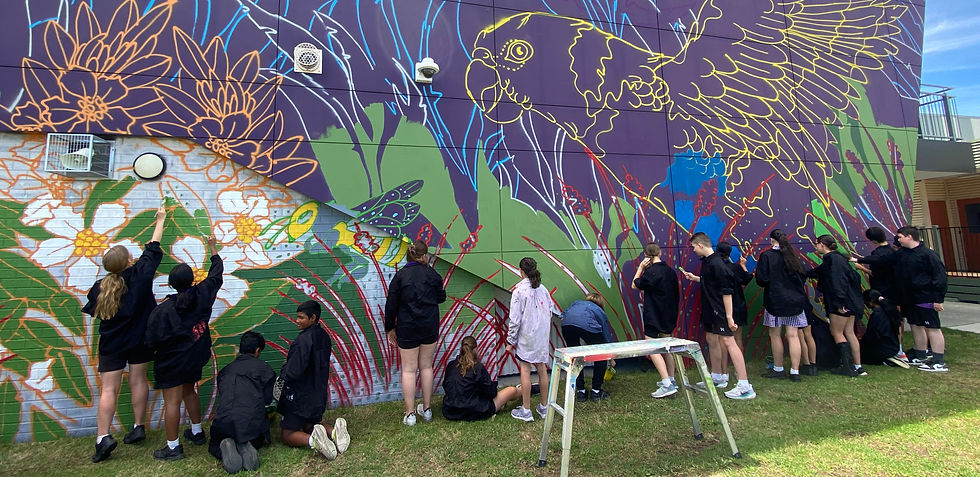
This is where the Creative Sparks Projects StreetLight Program sits.
Young people aren't simply brought in to paint someone else's design.
They help shape the story, ideas and visual identity of the project — then physically contribute to creating something that remains in their community.
That distinction matters.
The mural becomes a shared achievement.
Young people can point to it and say:
“I helped make that.”
That is a very different experience from simply being given an activity to do.
It creates an opportunity for agency, connection, contribution and belonging - while leaving a highly visible legacy in the place itself.

Prevention doesn't always look like prevention
For government and community organisations, this creates an important opportunity.
Early intervention doesn't always need to look like a traditional “prevention program”.
Sometimes it looks like:
A sports team.A mentor.A music program.A creative project.A young person finding their people.A young person discovering they have something valuable to contribute.
The Victorian VRU itself recognises the role of structured creative activities alongside sport and recreation. Its approach is built around early intervention and helping young people feel connected, valued and hopeful about their futures.
Creative place-making can be part of that ecosystem.
Not because painting a mural is the intervention.
Because meaningful participation is.
And when that participation gives young people voice, connection, confidence and a visible opportunity to contribute, the artwork becomes something more than an artwork.
It's evidence that they were heard. That they were listened to. And that they contributed.

The question isn't whether creativity can replace sport.
It can't, it shouldn't and it doesn't need to.
The question is whether we should give young people more pathways into the same things we know matter: confidence, connection, belonging, positive relationships and meaningful participation.
At Creative Sparks Projects that answer is 100% worth exploring.
Because sport is so much more than a game, and murals are so much More Than A Pretty Picture.


Comments